Event professionals have always been asked to create big moments. That part is not new. What has changed is the scale of inspiration clients are now bringing into the planning process.
A client may arrive with a Pinterest board, an AI-generated image, a celebrity gala reference, a luxury hotel lobby, a fashion runway, and a budget that looks more like it was written on a notepad during a coffee meeting than built for a full-scale immersive environment. (I say that with affection, because I understand both sides.)
Clients are not wrong for dreaming big. In fact, big vision is often where the best event design begins. A bold visual reference can tell us a lot about how a client wants people to feel in a space. It can reveal mood, tone, brand personality, energy, and aspiration. The challenge is that inspiration images do not come with labour plans, rigging requirements, freight costs, fire code considerations, venue restrictions, install and dismantle timelines, or the very real cost of skilled people making something look effortless.
This is where experiential design has to move beyond pretty pictures.
The gap between inspiration and execution
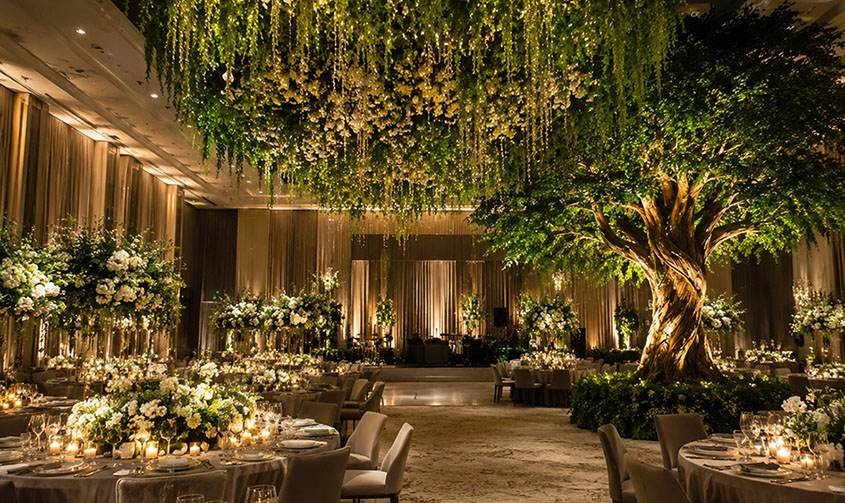
AI tools have made visual ideation faster and more exciting. A planner, designer, or client can now create a dream environment in seconds: floating floral clouds, impossible greenery arches, oversized sculptural trees, endless candlelight, immersive tunnels, glowing ceilings, branded photo moments, and perfectly styled spaces with no visible seams, cords, sandbags, fire exits, or budget limitations.
These images can be helpful. They can give a creative team a strong starting point. They can also accidentally create expectations that are disconnected from what is physically, financially, or logistically possible.
In real event design, everything has weight. Everything has scale. Everything needs to be moved, assembled, secured, powered, cleaned up, and removed. All by humans. A 40-foot ceiling installation is not just a design element. It is a production plan. A lush entry feature is not just an arch. It is fabrication, transport, safety, labour, timing, and venue coordination. Even a simple-looking lounge vignette requires decisions about traffic flow, sightlines, accessibility, durability, guest behaviour, and brand alignment.
Good design is not about saying no to the dream. It is about translating the dream into something that works.
Start with the feeling, not the picture
When a client shows me a highly aspirational reference image, the most useful question is not, “Can we build this?”
The better question is, “What do you love about it?”
Do they love the scale? The colour? The sense of arrival? The intimacy? The drama? The feeling of being surrounded? The way it creates a photo opportunity? The way it makes a corporate space feel warmer and more human?
Once we understand the emotional purpose behind the image, we can begin to design intelligently. Sometimes the client does not actually need the exact installation they are showing us. They need the feeling of transformation. They need guests to stop, look up, take a photo, feel welcomed, understand the brand, or move naturally through the space.
That distinction matters.
A full ceiling treatment may be out of reach, but a concentrated overhead moment above the registration desk or bar may create the same impact where it matters most. A room full of custom scenic pieces may not be realistic, but one strong entry feature, one branded photo moment, and thoughtful layering throughout the space can still create a cohesive experience. A client may dream of an immersive garden, but strategically placed trees, planters, lighting, and textured backdrops may deliver the atmosphere without overwhelming the budget.
The best event design is not always about doing more. Often, it is about knowing where the design will matter most.
Budget is a design tool
There is a tendency to treat budget as the thing that limits creativity. I see it differently. Budget is one of the most important design tools we have.
A clear budget forces prioritization. It helps identify the areas where impact is most valuable. It allows the creative team to decide what should be custom, what can be rented, what can be reused, what can be simplified, and what should be removed entirely.
Without budget clarity, everyone wastes time designing in the wrong direction. The client becomes attached to something unrealistic, the designer or planner has to manage disappointment, and the supplier is left trying to reverse-engineer a miracle.
With budget clarity, we can make better decisions earlier. For example, if the goal is guest photography, we may recommend investing in one high-impact feature instead of spreading décor thinly across an entire room. If the goal is atmosphere, we may focus on lighting, greenery, and spatial layering rather than complex custom fabrication. If the goal is sponsor visibility, we may build the design around branded focal points and guest flow. If the goal is warmth in a corporate environment, we may use texture, plants, soft seating, and scale to make the space feel more inviting.
A smaller budget does not have to mean a weaker experience. But it does require discipline.
The hidden costs of “simple”
One of the biggest misconceptions in event design is that if something looks simple, it should be inexpensive.
In reality, simplicity often takes more planning. Clean design leaves nowhere to hide. Minimal installations still require structure, proportion, finish, safety, and precision. A suspended floral piece may look airy and effortless, but the process behind it can include engineering, fabrication, rigging, lift equipment, staffing, venue approvals, and hours of installation.
This is especially true when clients are inspired by luxury environments. High-end design often appears calm, seamless, and understated. That does not mean it was easy. It usually means every detail was considered.
Part of our role as event professionals is to help clients understand what they are actually paying for. They are not just paying for objects. They are paying for expertise, logistics, problem-solving, risk management, creative interpretation, and a team that can deliver the design safely and beautifully in a limited amount of time.
The magic guests see is only possible because of the unglamorous work they do not see.
Designing for impact, not excess
Experiential design is not about filling every corner. It is about creating intentional moments that support the purpose of the event.
A strong event environment should help answer questions like: What should guests feel when they arrive? Where do we want them to gather? What should they photograph? How should they move through the space? What does the design say about the host, brand, or occasion?
This is where experienced creative partners can bring real value. We know when an idea needs more scale, and we also know when it needs restraint. We know when to spend money on height, lighting, texture, fabrication, or florals. We know when a design element will be beautiful in photos but impractical in a tight install window. We know when a concept needs to be adapted for safety, access, weather, venue rules, or guest interaction.
Most importantly, we know how to protect the client’s vision while making it achievable.
Collaboration makes the dream better
The best outcomes happen when clients, planners, designers, suppliers, venues, and production teams are honest and communicate with each other early.
If the budget is modest, say so. If the venue has restrictions, share them. If the install window is short, bring suppliers in before the design is finalized. If an AI image or inspiration board is driving the concept, use it as a conversation starter, not a construction drawing.
There is nothing wrong with dreaming big. Big dreams are part of what makes events exciting. But the role of an experienced event design team is to take that dream and shape it into something that can actually be built, installed, experienced, photographed, and remembered.
A successful event does not need to recreate an impossible image. It needs to create a meaningful moment for the people in the room.
That is the real work of experiential design: understanding the feeling, respecting the budget, solving the logistics, and creating something that feels effortless once the doors open.
Corinne Kessel, CSEP, is the principal of Greenscape Design and Decor Inc., a woman-owned, Burnaby-based company specializing in custom greenery, décor, and experiential installations for events and commercial spaces across Canada. With over 20 years of experience in event production and design, Corinne is passionate about creating intentional, inclusive, and sustainable environments that connect people to purpose through the power of design.